Templates
Attorney Email Signature: Examples and Bar Rules (2026)
What a lawyer's email signature must and should include, 6 copy-ready examples, and the 2026 rule changes on advertising labels and unadmitted staff.
An attorney email signature should show your full name, your title, the firm, the jurisdictions you are admitted in, and a direct way to reach you, plus a short confidentiality notice if your firm uses one. No ABA Model Rule dictates a lawyer’s email signature line by line, but the advertising and supervision rules decide what it must not imply: that you practice where you aren’t admitted, that you are a certified specialist when you aren’t, or that a law clerk is a lawyer.
Below: what to include, six lawyer email signature examples you can copy, the rules that actually apply (including New York’s June 2026 changes and a new October 2026 ethics opinion on unadmitted graduates), and how to keep every signature in a firm correct.
I’m not a lawyer and this isn’t legal advice. Rules vary by state, so confirm anything compliance-related against your own state bar’s current rules.
What should an attorney email signature include?
| Element | Needed? | Why |
|---|---|---|
| Full name (with “Esq.” or “J.D.” if your market uses it) | Yes | Identifies the responsible lawyer. Optional suffixes are convention, not a rule. |
| Title (Partner, Associate, Of Counsel, Law Clerk, Paralegal) | Yes | For nonlawyers, the title is what tells the reader they aren’t an attorney. |
| Firm name | Yes | Communications about your services have to identify a responsible lawyer or firm. |
| Jurisdictions of admission (“Admitted in NY and NJ”) | Strongly recommended | Stops the signature implying you can practice in a state where you can’t, especially at multi-office firms. |
| Direct phone and firm website or office address | Yes | Contact information for the responsible lawyer or firm. |
| Practice area | Optional | “Practices employment law” is fine. “Specialist” or “certified” has its own rule (see below). |
| Confidentiality notice | Optional, common | Signals privileged content. It is not a contract with the recipient. |
| Logo, headshot, LinkedIn, booking link | Optional | Fine if accurate. Keep images small so the signature loads on phones. |
What to leave out: inspirational quotes, client testimonials, “best lawyer” claims you can’t back up, and outcome statistics. Those are the parts of a signature most likely to be read as misleading advertising.
Attorney email signature examples
Plain-text examples you can adapt. Swap in your own details and the admission states that actually apply to you.
1. Solo practitioner
Jordan Ellis, Esq. Ellis Law PLLC · Estate Planning and Probate Admitted in New York (212) 555-0147 · ellislaw.com 150 Broadway, Suite 900, New York, NY
2. Partner at a multi-state firm
Priya Raman Partner · Harlow & Quinn LLP Admitted in California and Nevada Direct (415) 555-0182 · harlowquinn.com This email may contain privileged and confidential information. If you received it in error, please tell the sender and delete it.
3. Associate
Marcus Bell Associate, Commercial Litigation · Harlow & Quinn LLP Admitted in California Direct (415) 555-0190 · harlowquinn.com
4. Law clerk or graduate awaiting admission
Taylor Brooks Law Clerk · Harlow & Quinn LLP Not admitted to practice (415) 555-0175 · harlowquinn.com
5. Paralegal
Sam Ortiz Paralegal to Priya Raman · Harlow & Quinn LLP (415) 555-0161 · harlowquinn.com
6. In-house counsel
Dana Whitfield Senior Corporate Counsel · Northwind Logistics, Inc. Admitted in Illinois (312) 555-0133 · northwind.com
If you want a designed version rather than plain text, this is a real attorney template built in Firma. Open it to copy it into your own account.
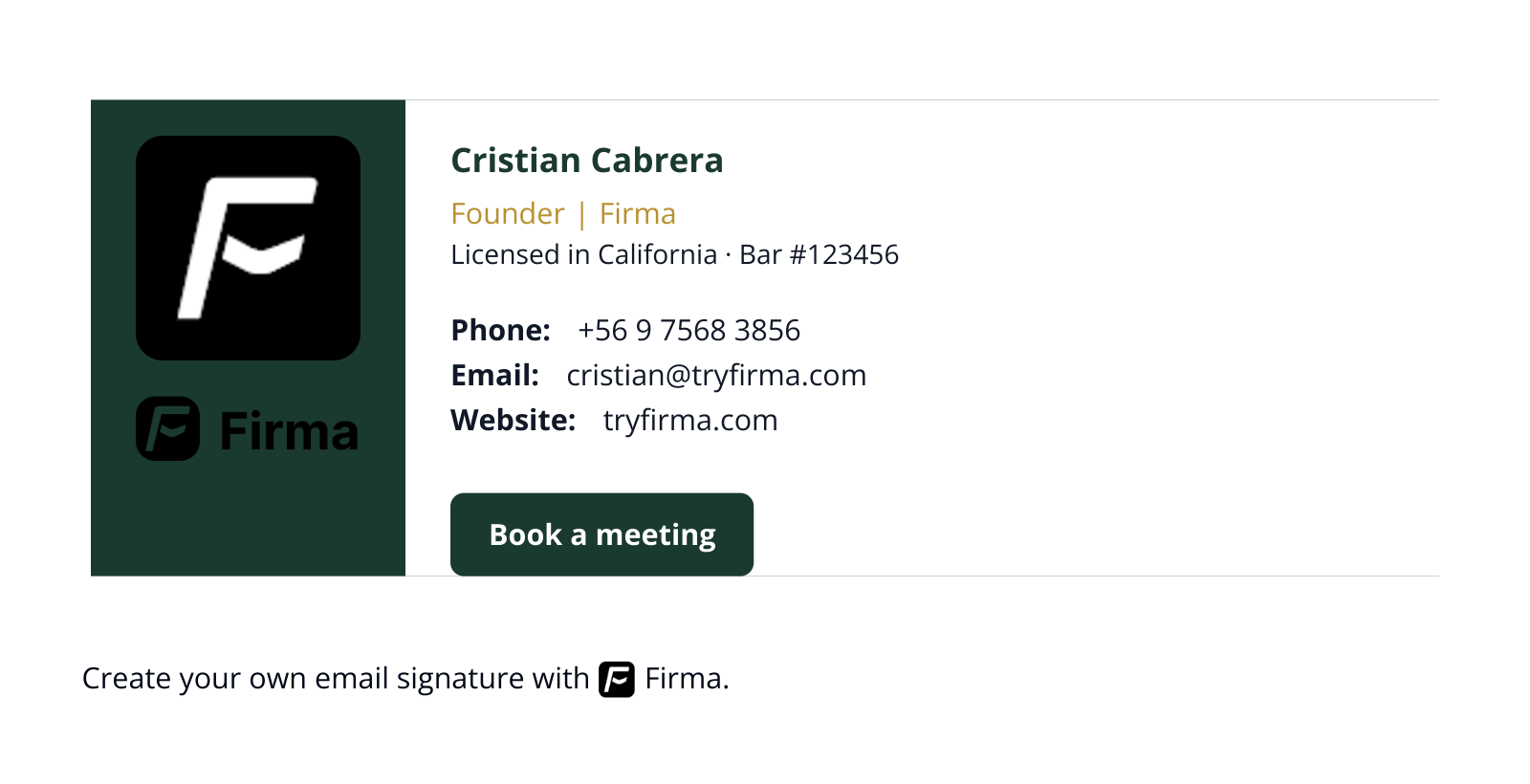
More layouts by role are in the professional email signature examples and the email signature examples gallery.
Which ethics rules apply to a lawyer’s email signature?
Your signature appears on every email you send, so bar regulators treat it like letterhead: a communication about you and your services. These are the provisions that matter, using the ABA Model Rules numbering that most states follow:
| Rule | What it means for your signature |
|---|---|
| 7.1 (false or misleading communications) | Nothing in the signature can mislead: wrong title, stale firm name, admissions you don’t hold, or a nonlawyer who looks like a lawyer. |
| 7.2 (advertising) | Advertising communications must include the name and contact information of at least one lawyer or firm responsible for the content. You can’t call yourself a certified specialist unless an accredited or state-approved body certified you and the signature names it. |
| 5.3 (supervising nonlawyers) | The firm is responsible for making sure clerks’, paralegals’ and assistants’ signatures don’t present them as lawyers. |
| 5.5 (multijurisdictional practice) | Listing where you’re admitted keeps a signature from implying you practice in a state where you aren’t licensed. |
| 4.4(b) (inadvertently sent documents) | A lawyer who receives a misdirected email must promptly notify the sender. This duty comes from the rule, not from your disclaimer. |
States adopt these rules with their own edits, so the paragraph letters and details can differ from the Model Rules.
Do lawyers still need “Attorney Advertising” in emails?
In New York, mostly no, since June 1, 2026. The old New York Rule 7.1 required the label “ATTORNEY ADVERTISING” in the subject line of advertising emails. Amendments effective June 1, 2026 replaced New York’s advertising rules with versions based on the ABA’s 2018 model. The New York State Bar Association’s summary says lawyers no longer have to put “attorney advertising” on everything they send, but communications must still include the name of an attorney or the firm and a way to reach them.
Two cautions. First, this applies to advertising: an email to an existing client about their matter was never an ad. Second, other states keep their own labeling and filing requirements for solicitations, so if you practice outside New York, check your state’s version of Rule 7.3 before removing any label.
How should law clerks and unadmitted graduates sign emails?
With a clear statement that they are not admitted. The NYSBA Committee on Professional Ethics addressed this directly in Opinion 1306 (October 14, 2026). Its conclusions:
- A firm may let law graduates who aren’t yet admitted sign appropriate email on the firm’s behalf, as long as the email doesn’t contain legal advice that requires an admitted attorney.
- A signature-block line such as “Not admitted,” “Not yet admitted,” or “Not admitted to practice” is sufficient, provided it clearly conveys the person is not admitted anywhere. No exact formula is required.
- On the firm website, the title “Law Clerk” is ordinarily enough on its own.
- The firm, not the graduate, carries the supervisory duty under Rule 5.3.
The same committee’s Opinion 1298 (2026) allows a candidate who has passed the New York bar exam but isn’t yet admitted to use the notation “Passed the NY state bar examination (passed not admitted).”
The practical problem is timing: a clerk who is sworn in needs their signature updated the same week, and a new clerk needs the “Not admitted” line from day one. That’s easy to miss when everyone edits their own signature.
Does a confidentiality disclaimer in an email signature protect you?
It helps, but it is not a contract. The recipient never agreed to its terms, so a disclaimer can’t by itself force a stranger to delete your email or keep it secret. What it does:
- Flags the content as privileged, which supports an argument that you intended to keep it confidential.
- Puts a receiving lawyer on notice, and that lawyer’s obligation to tell you about a misdirected email comes from Rule 4.4(b) and your state’s rules of civil procedure.
What it doesn’t do: fix a message sent to the wrong person. Your duty under Model Rule 1.6(c) to make reasonable efforts to prevent unauthorized disclosure is met by careful sending and secure systems, not by footer text.
Keep it short. Two sentences are read more often than a 200-word block, and a long disclaimer on every reply buries the actual message. A version that covers the essentials:
This email may contain privileged and confidential information. If you received it in error, please notify the sender and delete it.
If your firm requires longer language, put it in the signature of new emails and use the short version on replies.
How long can a lawyer’s email signature be?
Gmail allows up to 10,000 characters in a signature, which is more than enough. Length is a readability limit, not a technical one: aim for 4 to 6 lines plus a disclaimer of 40 words or fewer. If you add a logo or headshot, display it at about 200px wide or less so it doesn’t dominate on mobile; the email signature size guide has exact dimensions.
To set one up for yourself, follow the steps for Gmail or Outlook.
How do law firms keep every signature compliant?
Individual signatures drift. An associate makes partner and keeps “Associate” for months, an office moves, a disclaimer gets reworded but only half the firm updates it, and a clerk who’s sworn in still says “Not admitted” (or worse, a new clerk never adds it).
The fix is to manage signatures centrally instead of per person. With Firma, an administrator builds the firm’s templates once, with locked branding and the approved disclaimer, and deploys them to every account in Google Workspace or Microsoft 365 (through the Outlook add-in). Assignment rules by department or organizational unit put clerks and paralegals on a template that carries the “Not admitted” or paralegal title automatically, while attorneys get the version with their admissions. When the disclaimer changes, you edit it once and every signature updates. It’s free for up to 2 users, which covers a solo practitioner and an assistant.
FAQ
Should I put “Esq.” in my email signature?
You can, if you’re a licensed attorney and it’s customary in your market, but it isn’t required. “Esq.” is traditionally used only by admitted lawyers, so law clerks and graduates awaiting admission shouldn’t use it. Many lawyers skip it and let the title (Partner, Associate) and admission line do the work.
Do I need to put my bar number in my email signature?
The ABA Model Rules don’t require a bar number in emails. Bar numbers usually belong on court filings, where court rules may require them. Listing the states you’re admitted in is more useful to a client than a number.
Can I call myself a specialist in my signature?
Only if you’re certified as a specialist by an organization accredited by the ABA or approved by your state, and the signature names that organization (Model Rule 7.2). Describing what you do, such as “Practice focused on family law,” is generally fine as long as it’s accurate.
Should paralegals use the firm’s email signature?
Yes, with a title that makes their role clear, such as “Paralegal” or “Legal Assistant to [attorney].” Under Rule 5.3 the firm is responsible for nonlawyer staff not appearing to be lawyers, so give them their own template rather than a copy of an attorney’s.
Is “Attorney Advertising” still required in New York email signatures?
Since the June 1, 2026 amendments, the NYSBA says the label is no longer required on everything lawyers send. Advertising emails must still identify a responsible attorney or firm with contact information. Check the current rule text for anything you send as a solicitation.
What’s the difference between a law firm’s signature and an individual attorney’s?
The content is the same; the difference is control. A firm needs every attorney, clerk and paralegal on a consistent, approved version, which is easiest to manage centrally from one dashboard rather than signature by signature.
Cristian Cabrera, Founder of Firma
I built Firma so your team can have beautiful, consistent, professional email signatures — while you drink your coffee ☕️ instead of setting them up by hand for every new hire. It works like a charm with Google Workspace and Microsoft 365, and it doubles as a new marketing channel — announce a launch or promo right from everyone's signature. 😍 Here's my LinkedIn if you'd like to connect.